Thursday, September 26, 2019

A PICTURE PAINTS A THOUSAND WORDS


Before I share with you the photographic notion behind this phrase, do you know where the phrase originated? Its origin comes from the world of journalism. The original phrase was actually, "A picture is worth a thousand words." Find out more here.

So, now back to my tip of the month. When it comes to photo images, maybe it's not a thousand words we're talking about, but certainly several words that are part of a message, a translation, a feeling, a question, or maybe just a thought. We all have photos in our collection with that inherent quality. 

In this month's tip, I will share some images that have resonated with people. Look at them and ask, "What do I see? What do I feel?" What goes through your mind? What questions do they beg? The messages to these questions are different for all of us. They are our messages. What are your messages?


Let's start with this image. It was midday when I saw this homeless man. He was just quietly sitting, like contemplating life. I asked him if he' mind if I took his picture; that I found him very interesting. He said, "I didn't even shave this morning." Before I got this shot, I asked him, "What do you think of when you think of happy moments?" He quietly and softly replied, "My daughter. I don't get to see her much anymore." 

                                                             "Nowhere Man"

The harsh midday lighting mimicked his harsh life conditions.


It was early morning. A thick fog was still hovering over the landscape as I saw this scenario along a quiet hardly traveled county road. What do you see? What do you feel?


I'll let you stare at this next image first before I tell you the story behind the image.


This novel-like man was reading his paper and looking at paperwork as he sipped his coffee inside a Starbucks. True story. I photographed him through the store window. As I always do, I went inside and asked him if I could "take his picture."  


I got up extremely early this day to see what the Kings River in northern Arkansas might look like at that time, right before sunrise. The sun was just breaking the horizon when I created this image. What are your messages?


I thought I'd let you see this one first without an introduction. What do you see, feel,
hear, or think about when you see this woman sitting on her plastic bucket as she enjoys her early-morning fishing? Sometimes, the quieter, slower parts of life are the most enjoyable.


As I saw this early morning sunrise over the Ozarks in Arkansas, a feeling of tranquility enveloped me. Photography allows me to capture, to freeze moments in life; moments I may never see or feel again.


Some images, like this last example, just beg questions? What questions does it beg from you? How many words does it paint?


Sometimes, I know exactly why I point my camera at any given situation. However, at times my subconscious leads my mind, which leads me to point my camera at certain scenarios, places, or people. My conscious mind simply follows that lead, and it's not until after I look at my image that the message appears. For the image above, the questions for me are: Who is she? Why is she there alone? Where is she going? Where is she coming from? Why is she dressed like that? What are your questions?  


So, go out there and photograph people, places, cityscapes, landscapes, flora .....and follow your inner guide. Life is full of messages--capture them! 


Follow me and "like" me on Facebook (Eli Vega Photography).    


Wednesday, August 21, 2019

FLORALS

The reason I call myself a life photographer is because, although I too am attracted to landscapes and scenics as so many of us are, I can find art in almost any subject around me. One of those many subjects is florals, specifically flowers. 

I am not a botanist, so I am not as familiar with the many species of flowers around us. However, I don't need to be because when I'm out and about, my goal is not to take pretty pictures of pretty flowers. I look for shapes, colors, lines, and shadows. My imagination takes over from there and thinks of the unseen-- drama, moods, impressionism, mystery. beauty, etc.

Once I have something in my mind, then, and not only until then, do I start thinking about f/stops, shutter speeds, exposure, exposure modes, etc. In other words, I work backward.
I start with the end in mind. Of course, viewers don't know that. They only see the end result. So, let me show you some my end results. 

Let's start with this image, on which I received many comments and questions. I liked the shapes and colors of this midday arrangement, but the background was absolutely horrible. I also wanted to enhance the shapes and colors. So, to eliminate the ugly background and enhance the colors, I used a large black non-reflective flannel material as a backdrop then did an in-camera double exposure to create this. In my new book, RIGHT BRAIN PHOTOGRAPHY, I go into step-by-step detail on how I create my double exposures in camera. 


Don't be afraid to shoot toward the sun, even though most folks advise against it.
Get behind back lit subjects for unique perspectives. And, to add drama, increase your exposure to bring out those hidden details in the shadows--don't hesitate to disregard your histogram--it doesn't know what you want; it only knows what it thinks you need. I overexposed this scene by a +2 2/3!! That's 266% more light than my built-in light meter thought I needed. 


I liked these flowers, but the background was too busy, drawing attention away from the
"headliners." What to do? I gently slid my 32" diffuser behind the flowers in the foreground, slightly touching the flowers in the background to subdue their presence. It worked!


When photographing flowers in water, get down as low as you can in order to pick up their reflections in the water. It's not a comfortable position to be in, but the results are worth it. 


For this artistic rendition I used a combination of diffuser as a backdrop and an in-camera
double exposure. The result is a soft, artistic impressionistic effect.


The thought of white-on-white occurred to me when I saw this beautiful white bloom. So, a white diffuser behind a white flower seemed like the right thing to do. I don't like to overdo it when it comes to sharpening flowers--it counteracts the soft dream-like feel. 


For this last example, I want to show what a huge difference a diffuser makes when photographing flora. They help create the feel of in-studio photography, even though the actual photographs were done in the middle of the day with flowers in their natural environments..

Here is that studio look.


Now, if you don't think a diffuser makes a big difference, notice how this same scene looks like in its natural form. Big difference, right?


Have fun photographing flora. Go against common rules and no-no's. Don't think of them as simply "flowers." Treat them as elegant artistic subjects, and look, not for the labels for which they're known, but for the shapes, colors, forms, and moods they offer--go beyond the obvious.

Loosen up and enjoy creating art from nature! 
  

Monday, July 1, 2019

WATER

I enjoy photographing water--waterfalls, lakes, rivers, creeks, reflections, large and small bodies of water. I like to vary the times of day--early morning, broad daylight, late afternoon, or at twilight--that magic 10-minute window we have between sunset and nighttime.  

Water can be the main center of interest or play a significant role in the scene's composition. Its qualities can translate mystery, tranquility, drama, or fun adventures.

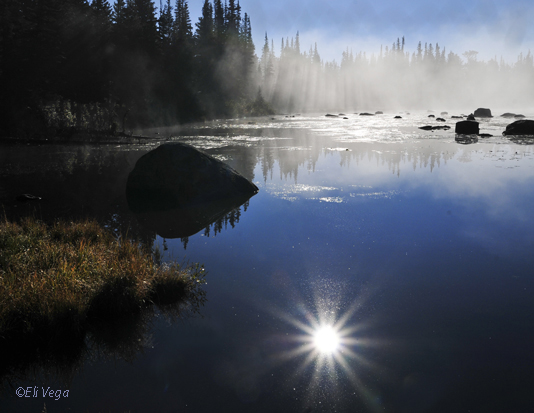
With that introduction, let me share the first piece from my collection. This is a relatively small lake in Colorado, near the Indian Peaks Wilderness northwest of Boulder. It's called Red Rock Lake. Shot early morning around 8:30, I underexposed the scene to retain the easy, tranquil feeling I was sensing that morning. I chose to include the sun only as a reflection in the lake, giving the scene a mysterious and mystical feel.


I stopped at Taylor Park Reservoir during one of my many drives between Buena Vista and Crested Butte, Colorado. The beautiful day attracted lots of boating enthusiasts. As I looked out at the lake, I noticed the shapes, forms, and designs the boats created on the water as they whizzed by. It intrigued me. For this shot, I added lots of water in order to emphasize the shapes created in the water by all the boats in the area.


The Great Salt Lake just outside of Salt Lake City, Utah is the largest salt water lake in the western hemisphere.It is 1,700 square miles and 75 miles long! I went to check things out one year, but I wanted to see what it gave me late in the evening. I liked what it gave me.   
I covered my view finder with two-thirds lake in order to emphasize its tremendous size.  


I just had to photograph this couple floating the Buffalo River in Arkansas. Their reflections, coupled with the reflections of the surrounding giant bluffs, really added interest and a sense of fun to this image.There are times when extremely slow shutter speeds (like 1 to 1/5 of a second) add to the photograph. This is not one of those times. I wanted to "freeze" the reflections and replicate the surroundings in the river as much as possible. A shutter speed of 1/250 did the trick. 


The Grand Tetons in Wyoming always make for great photographs. When I can find a reflection of them, they give me even more to enjoy. I found such a reflection in this small but perfectly located lake. This just goes to show that we can get good photos in the middle of the day. 


In nearby Colorado, I love to photograph one of the most beautiful but lesser-known lakes in this country--Hanging Lake. It is worth the extremely steep one-mile hike.


And, of course, waterfalls give us some dramatic views and sounds. My favorite waterfall in Colorado is Fish Creek Falls, just outside Steamboat Springs. May and June are the best times of the year, when snowmelt creates powerful waterfalls. You can feel the power underneath you, if you're close enough.


Blue Spring Heritage Center, near Eureka Springs, Arkansas is an interesting spot to visit. The best perspective is only a few yards away--a wide angle lens is definitely a must. 


Lake Luzern cuts through the city of Luzern, Switzerland. I love cities with bodies of water running through them. They add so much character. In addition, they make for great photos!
I prefer to shoot such scenes at twilight, to add color to the sky.


Every state has at least one body of water. Go find the lakes, creeks, rivers, or waterfalls in your state and have fun with them. Try different exposures, different times of day, different shutter speeds, and perspectives. And remember: there's no such thing as the "correct" exposure; there's only the right exposure, and you determine what that is for you! Enjoy.


Monday, June 10, 2019


TREES

Well, it's not really trees I want to talk about this month, but what trees can give us-- shapes,
lines, shadows, and even mood. The subjects, trees in this case, are secondary to what I want to create.

I don't photograph trees per se. Trees, in and of themselves, don't give me anything really
interesting. However, when I photograph them when light is the focus or at different times of  the day or year, or from different perspectives other than eye level, then the magic begins. Sometimes it's what I do with my camera or lenses that creates the magic. 

Here's a thought: Make my tip of the month an assignment for yourself. Give it your spin.


One of the most creative approaches I like to do with trees is create in-camera double exposures. In my book, RIGHT BRAIN PHOTOGRAPHY, I provide step-by-step instructions on how I do this. Basically, my first shot is slightly out of focus. I then superimpose my second shot, which is in sharp focus. When the two blend in-camera, it looks like this.

I would not suggest combining more than two images--it looks too "muddy" beyond two. 


Unique perspectives also give trees a unique look and appeal. Most people, when they do something like this, look straight up, from eye level. I placed my camera on my tripod near the tree on the left, only eighteen inches from the ground, and aimed straight up. All I could do was estimate the angle I needed. Based on my test shot from eye level, I knew I had to over-expose the image by + 2 2/3 stops. I also made sure my focusing point was about 1/3 from the bottom of my viewfinder, in order to get as much depth of field as possible. 


For these trees in the woods surrounded by an early snowfall, I simply moved my camera
downward slightly to create a painterly effect. This is more art than science, so it might take two or three tries to get what I want. I don't want to make my camera movement too fast or too slow. Too fast of a movement just gives me a blur; too slow of a movement makes it look like a mistake.  


I was walking along a dry river bed in Forth Worth, Texas looking for a good early sunrise shot of the Fort Worth skyline. Whenever I go on any photo walk or hike, I like to look behind me occasionally, to make sure I'm not missing out on anything. On this particular early morning, I couldn't see anything in front of me that caught my eye so I turned around and saw this scenario developing! Knowing the impermanence of the sun's location, I had to work fast. The colors in the eastern horizon, behind these interesting tree shapes, led me to reach quickly for my FLD filter, which gave this sunrise a unique effect. Get yourself an FLD filter and experiment with both sunrises and sunsets--they produce amazing results!

I first started experimenting with FLD filters during film days. They were designed to use when shooting under Florescent Lighting with Daylight film. Try it.   


Sometimes color itself can command the stage, as these dogwoods in spring in the Ozarks demonstrate. This scenario screamed color and shapes. 


You can't go wrong with simple autumn tree reflections in a body of water, as in this scene,
also in the Arkansas Ozarks. 


Have you ever tried photographing during the day with your white balance set on Florescent? 
Try it someday--you might surprise yourself. 


Trees in winter is also a favorite. I found these trees in Rocky Mountain National Park in Colorado during one of my winter workshops. There wasn't much color in the scene so I converted the original to a B&W image to emphasize white snow on dark bark.


Trees. They're all around us. We don't have excuses not to photograph them. Think perspective, reflections, the four seasons, on-camera filtration, double exposures, camera movement, out-of-the box white balance, black & white images, and other approaches I didn't mention. 

Our eyes are limited. Our imaginations are endless. I don't see with my eyes; I see with my imagination.     


Tuesday, April 30, 2019

PHOTO SOFTWARE SURPRISE


This is the first time I have shared what I sometimes do with my photo editing software, beyond just fine-tuning my images. Sometimes I take my images outside the realm of "photography" and into the arena I call either "hybrid photo art" or "digital mixed media."

This is no longer photography. It starts with a photograph, the way many canvas painters use a snap shot as their starting point then build from it. For this reason, I don't refer to it as my photography, or my photography skills. It's a different type of art done via computer software. If I had an exhibit of my art, I would have a different section labeled either Digital Mixed Media or Hybrid Photo Art. 

With that introduction, let me share some fun things I do in my downtime when I have extra time to just play around and have fun with it. 

My goal is to encourage some of you to experiment with whatever software you have. If you don't consider yourself a good photographer, you might try converting some of your photos to digital mixed media. Or, even if you are a good photographer, some of your images might also look good in this format.


Hot Springs, Arkansas is known for its natural hot springs. There is one hot springs where you can actually soak in them, like in old Greek fashion. I photographed a group of bathers, then took my photo and used an application called Artistic Cut Out. It gives a photo image an interesting painterly effect. 

                                                                  
                                                           "The Bathers"


I found this surreal abandoned manufacturing plant in Laramie, Wyoming. One of the exterior walls was riddled with graffiti. I liked the image, but this also looked interesting. I applied what's called Poster Edges, which posterizes adjoining pixels to give it this effect. Before photo editing software, it was used to create posters. It's the most-used application in my repertoire.


This old fire truck in Colorado was done the same way (poster edges). Although it's the same application, the results are different, depending on the subject, lighting, etc. There are also three different sliders to which you can adjust three different variables, which also varies the final results. 


Here is what Poster Edges looks like when applied to photos of people. The original photo to which this was applied was a double exposure, thus the "double" feel to it. 


This is a more severe application, with very dramatic effects. It's called a Solarize filter, which I think is a misnomer. I see it as a computer-generated application, not a filter. But, hey, I didn't design the software. 


This next effect is for intentional distortion. It's called Spherize and distorts the image into a sphere shape. You can control for the degree of distortion. The original image is a photo of plants. As with any art, it all depends on which application you prefer and the degree of that application. Sometimes I try a certain effect and reject it immediately as an experiment that just didn't work for me.


Here is another example where I applied the Solarize filter, like the butterfly above, but I liked the effect on this particular image better. I like what it did to the sky on the original photo of a sculpture. 


I also applied the Poster Edges effect to the following example, but, again, different results on these tulips.


These next two examples have the same application, but, as you can see, it too also has different effects on different subjects. This application is called Plastic Wrap.


Here's the second Plastic Wrap example--a totally different feel to it. I really liked the effect it had on this kite. For this one, after I applied plastic wrap, I converted the sky to black & white and left the kite in its original color. Kites have come a long way since I flew them as a kid!! 


I'll leave you with one more application--Glowing Edges. This is nothing other than a close-up of a large light bulb. 


I shared six different computer-generated applications. So, as you can see, you can have a lot of fun with the medium of Digital Mixed Media, aka Hybrid Photo Art. Take any photo and start experimenting. You might surprise yourself and discover a new form of art! 


Follow me on Facebook (Eli Vega Photography). All images shared on my blog and on FB are available as fine art prints. 


Monday, April 22, 2019

SURREALISM THROUGH PHOTOGRAPHY 


I have been fascinated by surrealism since my art days in college. Of all the masters of the genre, Salvador Dalí still remains the godfather of surrealism. 

Some of the characteristics of surrealism include the element of surprise and the unexpected, both of which might cause a sense of awe and bewilderment. Imagery can at times be a bit bazaar and leave folks scratching their heads.

As for my photography, it isn't always bazaar like some of Dalí's works. Most often it's the angles I choose, the subjects I pick to photograph, and the techniques I use. Combined, they all possess some of the characteristics of surrealism. Sometimes, when seen out of context, my images might take a few seconds before the viewer figures out what it is.

With that, let's start with this image. I'm always on the lookout for the "out-of-place"--scenarios that are unlikely, not the usual, not the common. Such was this scenario. I was on the second floor of an old historic hotel. I walked up a long spiral staircase to get to the second floor. As I looked down from the second floor, looking back at where I had just walked, I saw this. Someone who worked for the hotel had decided that at the bottom of the stairs, on the first floor, would be a great place to set up an office. Note the office table, a computer monitor, lamps, and office chairs.


I love coffee shops, especially home-grown local shops. They are so much friendlier and the atmosphere so relaxed and personable, compared to those "chain" coffee places. I found one of those local places in Steamboat Springs, Colorado. Unfortunately, it no longer exists! Before I ordered, I had to go to the restroom. The moment I opened the door, Salvador Dalí greeted me with this!!


A local artist had painted a jungle themed mural inside the men's restroom! Of course, I never found out if the women's restroom was similarly decorated. I call it "It's A Jungle In There." 


One of our neighbors has an artificial skeleton. I don't know what material it's made of but it looks amazingly real. He places it on a tree in front of his house and decorates it according to the seasons or annual holidays. It was dressed up for St. Patrick's Day the day I saw this surreal backdrop of dogwoods. If you look for it, surrealism can be just around the corner, literally.


Believe it or not, I saw this grove of mysterious pines from a two-lane road. I was going around 60 mph when I got a quick glimpse of them. I just had to turn around and follow my intuition. I walked in front of this grove for several minutes, left-to-right; right-to-left. Then I saw it! It was as if the trees had created a path for me while whispering, "This is your path."
The conversion of the original to a B&W image enhanced the mystique, especially the way the tall dry grasses turned ghostly white. 


I will show this next image first before I comment on it.


Last year, a team of creative folks in the quaint historic town of Eureka Springs, Arkansas (which I call home), including a team from the majestic Crescent Hotel, painted several donated bikes as part of a new downtown bicycle art project. It was fun photographing the bikes as several folks aimed their spray cans at them.

Fast forward to March 2019. We had our first snow, and I just had to tow my camera to wherever I could find some "canvases" to paint with my camera. As I drove down Main Street, I saw all the bikes against a backdrop of white snow. This green one caught my attention. There are several details about this image that qualifies it as surreal. First, a flat green bike. Second, the bow. Third, the Mardi Gras beads hanging from the handle bars.

The unexpected; the unusual; the element of surprise. 

A tip for photographers: you don't need to photograph the entire subject to translate the essence of it. Sometimes, the extraction from the whole can be more powerful.


For this last example, I will again show it first then comment after you absorb it. 


I saw this giant young woman staring at what appeared to be two toy VW buses, as if playing with them. The buses are real. The woman is a giant mural on the wall of a building nearby. I positioned myself to where I could only see one of her eyes between the two vehicles to add to the surrealism. By the way, this was in Colorado--those are not pine trees depicted on that sign on the door. Think what plant is legal in the state. 


I hope I gave you some ideas for you to go out and look for the unexpected, the unusual,
the weird, the surreal. 


Have fun with it!

Eli Vega, author of the award-winning book, Right Brain Photography (Be an artist first).